
Program

This conference provides lens researchers with the unique opportunity to meet in a casual atmosphere to exchange the latest breakthroughs in lens research and establish collaborations over meals, while also enjoying the many wonderful activities available in Kona, Hawaii.
The scientific program for the 10th ICL is being spearheaded by Dr. Steven Bassnett of the Washington University School of Medicine in St Louis, Missouri and Dr. Kevin L. Schey, of the Vanderbilt University Department of Biochemistry in Nashville, Tennessee
Click here for a copy of the 2025 ICL Final Program Booklet
Click here for a copy of the 2023 ICL Program Booklet
2025 ICL Meeting brings together researchers from the US, Greece, Spain, Canada, China, Japan, New Zealand and Australia
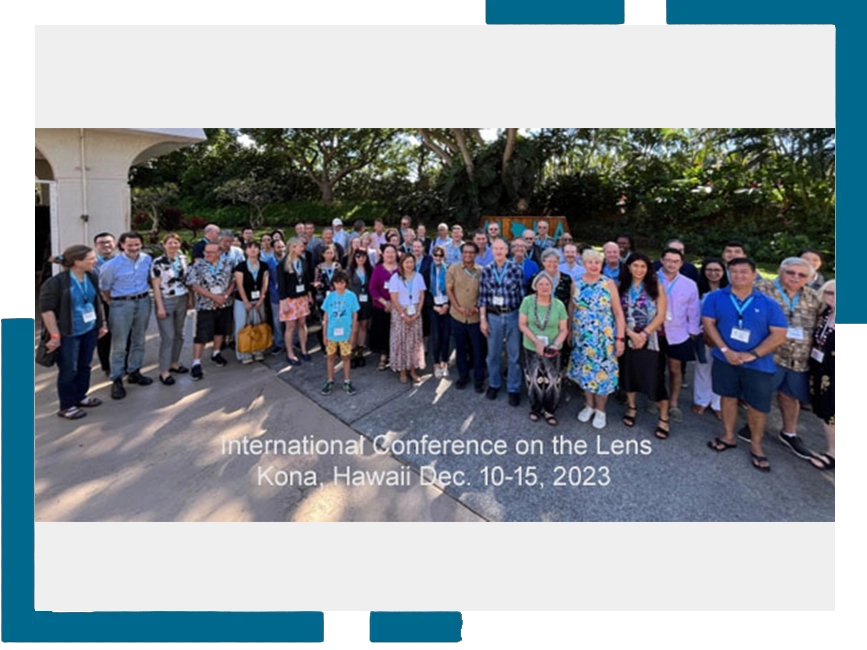
The 2023 meeting was attended by 85 Scientists from Australia, Canada, China, England, Japan, Mexico, New Zealand, and the United States.
Social and Scientific Program ICL 2025
Sunday
3:00 PM - 6:00 PM Registration at the Kaleiopapa Convention Center
6:00 PM Plenary Lecture Noboru Mizushima (University of Tokyo): Intracelular degradation by autophagy and PLAAR family lipases.
7:00 PM Welcoming Reception at Kaleiopapa Convention Center
Monday
8:15 AM Welcoming Remarks
8:30 AM Session 1: Lens Cell and Matrix Biology
Cathy Cheng & TJ Plageman
- TJ Plageman: Arvcf-dependent cell adhesion at lens sutures
- Justin Parreno: F-actin reorganization as a regulator of epithelial-mesenchymal transition in a serum/growth-factor free ex vivo model of lens fibrosis
- Juliet Moncaster: Microtubule-Associated Protein Tau (MAPT) in mouse non-transgenic and transgenic Alzheimer's Disease lenses
- Matthew A. Reilly: The Lens’ Gradient Refractive Index Deteriorates Upon Removal of the Capsule and Epithelium
- Cathy Cheng: Eph-ephrin signaling affects lens growth and shape, nucleus size, and gradient refractive index in adult mice
10:00 AM Short Break: Tea/Coffee
10:30 AM Session 2: Lens Differentiation
Amer Riazuddin & Salil Lachke
- Amer Riazuddin: The role of autophagy in lens fiber cell differentiation
- Michael L. Robinson: FOXE3 transcriptional targets suggest a role for FOXE3 in suppressing neural differentiation
- Jared Tangeman: Leveraging single-cell multiomics to resolve gene regulatory networks governing lens fiber cell differentiation
- Velia Fowler: Delayed Fiber Cell Maturation in CAP2cKO Mouse Lenses
- Salil Lachke: Ell2 is necessary for optimally accessible chromatin in early differentiation stages to achieve high levels of select transcripts in fiber cells
12:00 PM Break: Lunch
1:15 PM Session 3: Structural Biology and Biophysics Rachel Martin & Tamir Gonen
- Rachel Martin: Biophysical characterization of site-specifically oxidized lens proteins
- Shane Gonen: CryoEM imaging methodology for difficult protein targets
- Rachel Klevit: Parsing the grammar of small heat shock proteins
- Tamir Gonen: MicroED solution to the lens MP20 enigma
- Haruka Matsumoto: Analysis of cataract pathophysiology analysis at the molecular level using mass spectrometry imaging
2:45 PM Short Break: Tea/Coffee
3:00 PM Session 4: Cataract Genetics
Elena Semina & Anne Slavotinek
- Elena Semina: Uncovering new genetic f ctors in pediatric cataracts
- Gavin Arno: Nanopore sequencing transcript analysis and functional investigation of a novel CYP51A1 genotype confirms the gene’s association with autosomal recessive congenital cataract
- Hélène Choquet: Novel cataract risk loci identified from a large-scale multiethnic genome-wide association meta-analysis
- Fielding Hejtmancik: Aspartyl (Asparaginyl) beta-Hydroxylase deficiency impairs lens placode invagination and lens development in a Traboulsi syndrome Mouse Model
- Anne Slavotinek: Single cell RNA-Seq in a zebrafish model of crim1 loss of function – uncovering gene regulatory networks and mechanisms for lens development
Tuesday
8:30 AM Session 5: Lens Signaling
Xin Zhang & David Li
- David Li: Regulation of Lens Development by Pax6 Sumoylation
- Haotian Lin: Digital Twin of the Lens and AI-Assisted Diagnosis and Treatment of Cataracts
- Xiangjia Zhu: Pathogenetic Mechanisms of Highly Myopic Cataract
- Qian Wang: Dynamic regulation of FGF signaling in lens development
- Michael Karin: Oxidized mitochondrial DNA and systemic autoimmune diseases
10:00 AM Short Break: Tea/Coffee
10:30 AM Session 6: Crystallin Modifications and Cataractogenesis Kirsten Lampi & Eugene Serebryany
- Eugene Serebryany: Investigating the mechanism of suppression of γ-crystallin misfolding and aggregation by the abundant lens metabolite myo-inositol
- Adam Miller: 𝛼𝛼-crystallins play the long game
- Laxman Mainali: Aggregation of α-Crystallin to Lens Membrane Increases with Peroxidation of Lipid and Cholesterol
- Constance Kraay: Unfolding Intermediates of γD-Crystallin and γS-Crystallin Identified in silico Provide Insights into Mechanisms and Suppression of Aggregation
- Kirsten Lampi: Stepwise Mechanism of Crystallin Insolubilization due to the Synergistic Effects of Deamidation and Oxidation
12:00 PM Break: Lunch
1:15 PM Session 7: Lens Clinical Studies
Hiroshi Sasaki & Eri Kubo
- Hiroyuki Matsushima: Biocompatibility and Functionality of Intraocular Lens Materials
- Yoichiro Masuda: From Atopic Cataract to IOL Dislocation: A Pathological Journey Through the Lens Capsule
- Andrew Smith: LEFTY2 is an Aqueous Humor Biomarker for Exfoliation Glaucoma
- Takayoshi Sumioka: Dead Bag Syndrome after Cataract Surgery: Pathological Findings and a Representative Case
- Takashi Ono: Optimizing Systemic Care in Cataract Surgery for the Super-Aged Society
2:45 PM Short Break: Tea/Coffee
3:00 PM Early Career Cataract Research Award Presentation
3:05 PM NFER Cataract Award Talk Xiangjia Zhu
3:30 PM Poster Lightning Talks Nick Delamere
4:15 PM Poster Session
Wednesday (Half-day)
8:30 AM Session 8: Redox Biology & Cataract
Julie Lim & Xingjun Fan
- Xingjun Fan: Lipid Peroxidation Increases Lens Stiffness and Plasma Membrane αA-Crystallin Association
- Hongli Wu: Redox imbalance triggers lens inflammaging and senescence: insights from Grx1/Grx2 double-knockout mice
- Kim Jiang: Investigating the molecular mechanisms involved in cataract formation post vitrectomy
- Yu Pu: Removal of N-terminal cysteines from γD-crystallin generates aggregation-prone dimers
- Vincent Monnier: In silico methods for improving binding affinities of gamma crystallin aggregation inhibitors
- Julie Lim: Unlocking the clock: bringing
10:00 AM Short Break: Tea/Coffee
10:30 AM Session 9: Lens Optics & Biomechanics
Barbara Pierscionek & Kehao Wang
- Barbara Pierscionek: Reflections on the optics of the lens
- Ji He: Individual Variation of Refractive Index of the Crystalline Lens of the Normal and Cataract Eyes
- Qing Li: Retrieving the gradient refractive index structure of the crystalline lens from the wavefront aberrations over two-dimensional visual field
- Alyssa Lie: An in vivo MRI study of changes in lens water distribution with cataract development
- Kehao Wang: Biomechanical simulations reveal key parameters that affect lens accommodation
Afternoon Free / Golf Tournament
Thursday
8:30 AM Session 10: Lens Membranes & Physiology
Tom White & Paul Donaldson
- Jean Jiang: Dual-domain Regulation of Connexin 50 Suppresses Lens EMT and Post-surgical Fibrosis
- Taishi Painter: Role of Slc20a2 in Lens Growth and Fiber Cell Differentiation and Elongation
- Yadi Chen: Regional differences in Ca²⁺ mobilization mediated by zonular tension in the rat lens
- Nikhail Nair: Dissecting the contributions of AQPs to regional lens water homeostasis: insights from lens nanovesicle and hydrostatic pressure analysis
- Nick Delamere: A comparison of hydrostatic pressure responses to Piezo-1 and TRPV4 in the mouse lens
10:00 AM Short Break: Tea/Coffee
10:30 AM Session 11: Lens Development and Regeneration Kelly Tseng & Mason Posnere
- Irene Vorontsova: Cross-talk between lens power and axial eye length: Unravelling mechanisms leading to myopia
- Hideaki Morishita: PLAAT phospholipases drive autophagy-independent organelle clearance in the lens for transparency
- Wei Li: PLCϒ functions in lens vesicle separation by modulating FGF signaling
- Kelly Tseng
- Konstantinos Sousounis: Cellular states and trajectories during newt lens regeneration
12:00 PM Break: Lunch
1:15 PM Session 12: PCO, Fibrosis and EMT
Janice Walker & Michael Wormstone
- Janice Walker: Defining the metabolic and bioenergetic requirements that fuel the lens response to injury to promote a fibrotic outcome to wounding
- Promita Deb: Role of α5β1 integrin in the pathogenesis of fibrotic posterior capsular opacification (PCO)
- Lan Zhang: CREB controls STING-Mediated Signaling of Inflammatory Response of the Ocular Lens through the Transcriptional Repressor REST and STING ISGylation during Lens Fibrosis
- Qiuli Fu: Generation and application perspectives of regenerated lens during cataract treatment
- Michael Wormstone: Menadione-induced depletion of glutathione (GSH) impairs lens epithelial cell function and viability: A potential strategy for posterior capsule opacification management
2:45 PM Short Break: Tea/Coffee
3:00 PM Session 13: Crystalline Lens Optical Evaluation; Inspiration and Guidance for IOLs and Presbyopia Treatment
Susana Marcos
- Susana Marcos: Crystalline lens full 3-D geometry: implications for intraocular lens development and selection
- Kirill Larin: Optical Coherence Elastography and Brillouin Spectroscopy of Crystalline Lens
- Liane Clamen: Development of an Accommodating Intraocular Lens that Mimics the Young, Human Crystalline Lens
- Andres de la Hoz: Finite element models of accommodation for estimation of crystalline lens material properties
- Alberto de Castro: Optical coherence tomography to study the gradient index of refraction of the human crystalline lens
- Eduardo Martinez-Enriquez: Eigenlens geometrical representation of the crystalline Lens
4:30 PM Break
5:30 PM The Kinoshita Lecture John Clark
6:30 PM Cocktails and Conference Banquet at Bayview Grounds
Friday (Half-day)
8:30 AM Session 14: Molecular Aging in Lens and Non-Lens Tissues
Kevin Schey & Christina Karakosta
- Christina Karakosta: Comparative Proteomic Analysis of Aqueous Humour, Anterior Lens Capsules, and Crystalline Lenses in Different Human Cataract Subtypes versus Healthy Controls
- Sarah Zelle: Analysis of adult Nrf2 and αB-crystallin mutant zebrafish lenses exposed to oxidative stress reveals shifts in the lens proteome
- Preston Hazen: N101D Deamidation and Cholesterol Content Differentially Impact the Membrane Binding of αA-Crystallin to Model Human Lens Lipid Membranes
- Kevin Schey: Molecular Aging in the Lens: What are We Missing?
- Lee Goldstein: Molecular Aging and Diabetic Protein Glycation Detected and Tracked In Vivo by Quasi-Elastic Light Scattering Spectroscopy Scanning of the Lens
10:00 AM Break: Tea/Coffee
10:30 AM Session 15: No Lens is an Island
Steve Bassnett & Katelyn Swindle-Reilly
- Katelyn Swindle-Reilly: The Lens Is Not an Island: Strategies from the Vitreous to Support Lens Health
- Jodi DeDreu: How the lens functions in regulating immune responses to maintain/restore homeostasis in the eye
- Marco Ruggeri: Quantifying the Ciliary Muscle in Accommodation with Optical Coherence Tomography
- Juan Rodriguez: Tweezing out zonular mechanics
- Steve Bassnett: Developing an Anatomically Accurate Base Model of the Human Eye with Emphasis on the Zonular Apparatus
12:00 PM Closing Remarks and Depart